How it works in daily practice
Step 1/3: You collect data
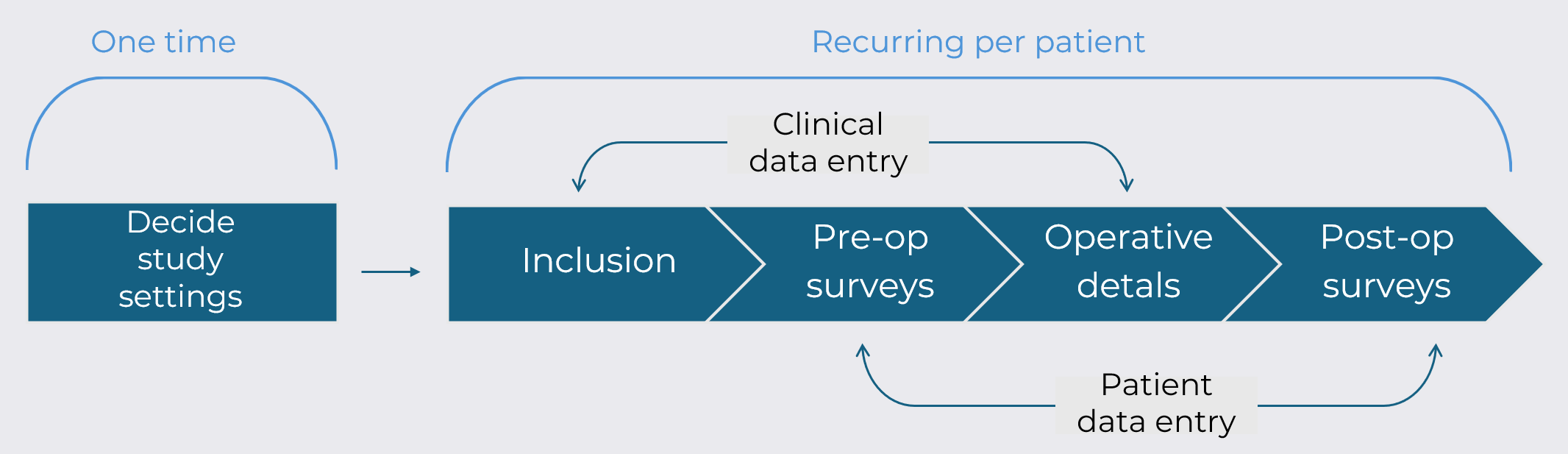
We know that not all data collectors have the same research goals, so MyOrthoData prioritizes flexibility. You choose which interventions you’d like to track, questions to send to patients, and at which timepoints data should be collected. Then, you start recruiting patients.
Minimal data collection requires about 1 minute of data entry per patient for clinicians, for automatic data collection to start. You additionally have the option to fill in surgical data at the time of operation, to the degree which is desired for your research goals.
Step 2/3: Private dashboards are generated
Two dashboards are generated automatically:
1. Your practice
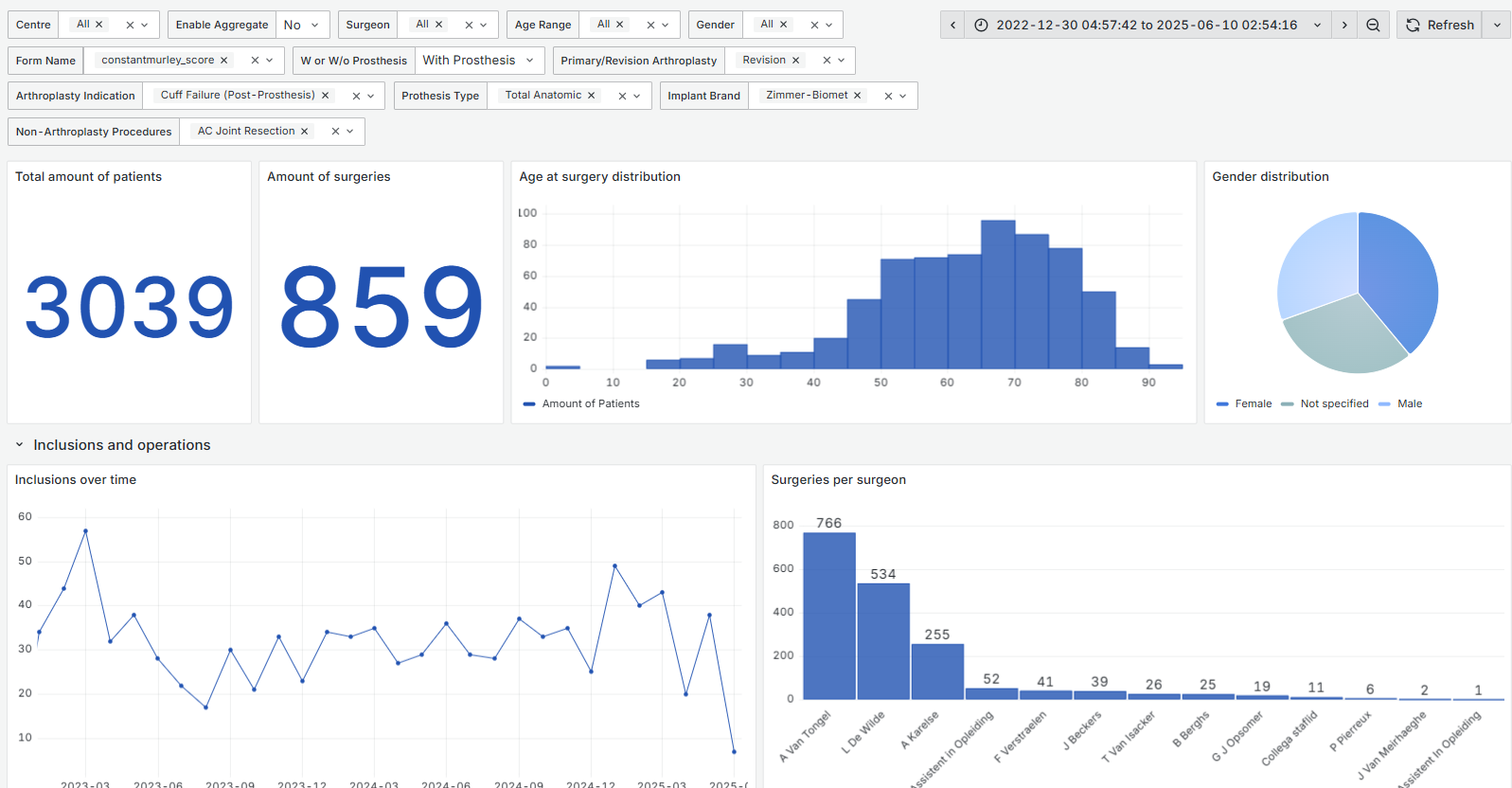
The first dashboard gives an oversight of all registered data, including demographic trends, PROM averages, response rate to follow-ups, and more. You can filter data to look at specific
target groups.
2. Your patients
The second dashboard lets you zoom in to patient-level. Here, you can see a quick overview of individual patient’s demographics, self-reported recovery progression, response rate, and any adverse events.
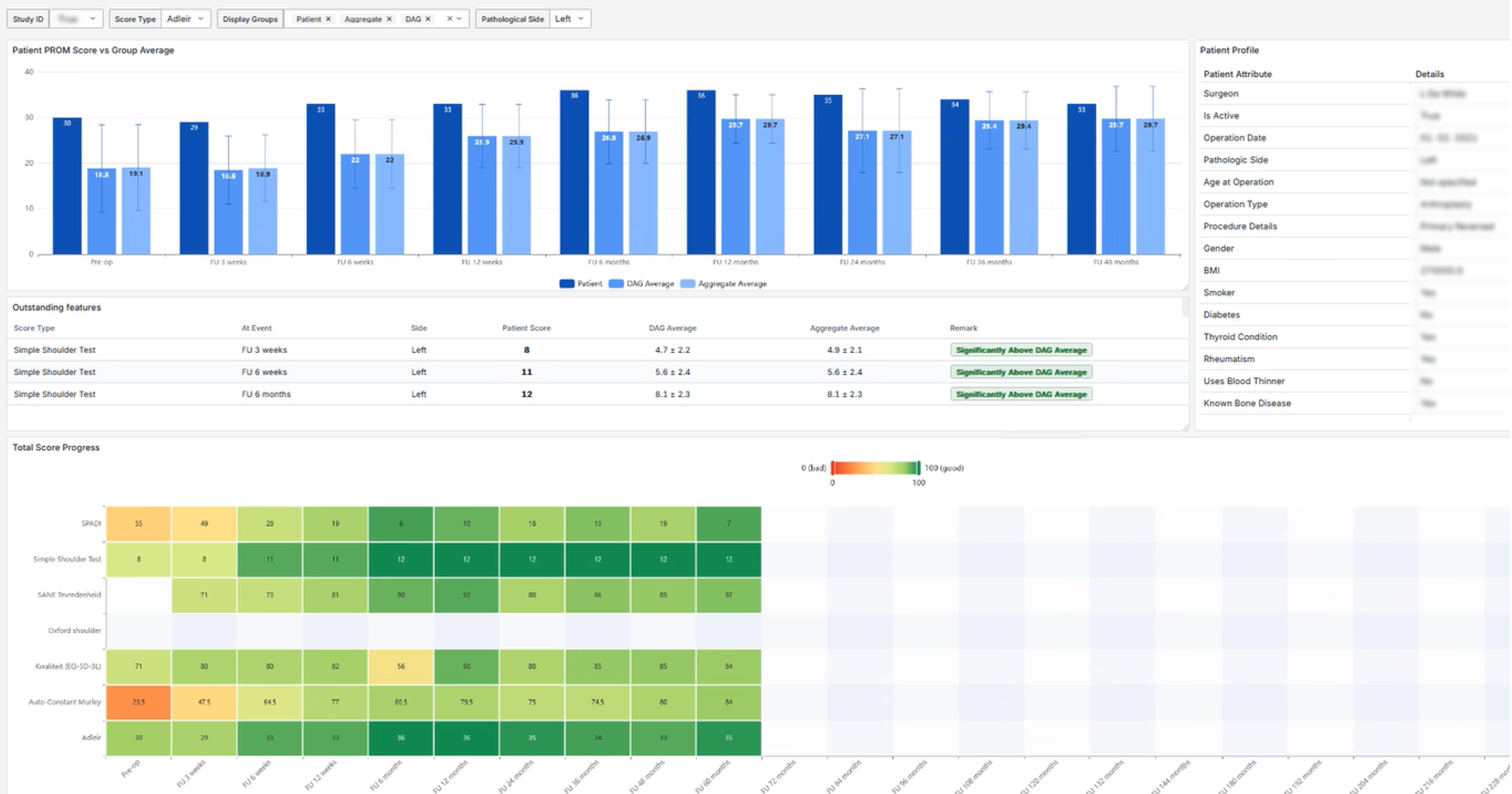
For both dashboards, you can also opt-in to see your data benchmarked against a consortium-based cohort. This optional feature can give valuable insight into broader trends and inspire directions for collaborative research. Data included in benchmarks are always fully anonymized and cannot be traced back to you or your patients.
Step 3/3: Export, download, or migrate your data anytime
You can download your data at any time (the full dataset or any subset).
A variety of easy export formats are supported:
Data are stored in standard data formats when possible to support migration between systems and registers (Orthopride and more). This is part of our vision for sustainability and usability.
Excel/CSV, SAS, SPSS, Stata, R, & XML.
PROMs, Timepoints, and Languages
The research scope, follow-up interval, and languages used are fully customizable.
For a list of our currently supported options, click on the drop-downs under each joint.
-
Tendon & trauma
Arthroplasty
Instability
Conservative treatment
-
General health
Pre-op shoulder amnesis
Post-op satisfaction
Constant Murley score
Oxford shoulder score
SPADI
Simple shoulder test
ADLEIR
Eq5d3l
-
Pre-op
3 weeks
6 weeks
12 weeks
6 months
Annual up to 20 years
-
English
Dutch
French
German
Polish
Italian
Romanian
European Portuguese
Shoulder
-
Prosthesis
Non-prosthesis
-
General health
Pre-op elbow amnesis
Pre-op expectations
Post-op Satisfaction
Auto-constant murley score
SANE
Simple shoulder Score
Eq5d3l
-
Pre-op
3 weeks
6 weeks
12 weeks
6 months
Annual up to 20 years
-
English
Dutch
Elbow
-
Arthroplasty
Ligament surgery
Patellar instability
Meniscus
Osteotomy
-
Pre-op knee amnesis
General questionnaire
Short ACL-RSI
Banff patella instability
Eq5d3l
Forgotten joint score
IKDC Subjective knee score
I-PRRS
KOOS & KOOS-PS
Knee society score
K-SES
Lysholm score
Marx Activity scale
Norwich patellar instability
Oxford knee
Pain (VAS)
Pain catastrophizing scale
PROMIS (v1.2)
Satisfaction (VAS)
Tegner
WOMAC
-
Pre-op
3 weeks
1 month
6 weeks
12 weeks
3 months
6 months
9 months
Annual up to 20 years
-
English
Dutch
French
Knee
-
Arthroplasty
Osteotomy
Ligament
Hindfoot osteotommy
-
General questionnaire
Pre-op amnesis
Post-op satisfaction
AOFAS
EFAS
Eq5d3l
KOOS
Lysholm
Oxford
Tegner
VAS
-
Pre-op
3 weeks
1 month
6 weeks
12 weeks
6 months
9 months
Annual up to 20 years
-
English
Dutch
Ankle
Our offer for joints, PROMs, timepoints, and languages is constantly expanding. If we are missing functionality which is valuable for your research, let us know so that we can improve our offer.
A quick informational video which shows how data entry works in daily practice.
FAQs
-
Absolutely - see subpage “What we do“.
-
Depending on the scope of your research goals, about 1-5 minutes are required from the surgeon and 5-15 minutes are required from administrative staff, for each patient record.
At each follow-up, 5-20 minutes are required of the patient. The total time requirement for patients is dependent on the scope of PROMs and the number of timepoints at which they are collected.
-
Yes. There are several packages for PROMs and timepoints, from which you can choose.
-
Data is stored on a server at your instituion, or trusted by your institution. Data is encrypted and protected by firewalls for security.
-
There are several options for data storage, including storage at your institution. You can read the data handing agreement, or ask us, for more information about the requirements associated with local data storage.
-
Only individuals from your research group and/or trusted data managers have access to your data. Users from other institutions cannot view, edit, or export your data.
-
You and/or your institution.
-
Yes - If you would like to publish your results, you can do so as long as you cite this initiative and REDCap.
If you would like to sell your data to a third party/medical company, you may do so on the condition that a percentage of the proceeds go towards the not-for-profit furtherment of MyOrthoData.
All details on these agreements can be found in the our legal contract regarding inter-site collaboration, available upon request.
-
We don’t want to sell a product - we want to connect and support evidence-based care.
If you decide to sell your data, we request a small percentage of the profits to help with academic database sustainability, but that’s it. You can find out more about this by reading the data handling downloads below, or by shooting us an e-mail.
Helpful downloads which give detailed information about how we work. If you can’t find the answer to your question, feel free to reach out.